
Three Harnett Release Dates
Minimum term, projected date, and actual release are not interchangeable. Under North Carolina Structured Sentencing, the minimum term is the floor an active-sentence felony offender generally must serve. A projected or tentative date is an administrative calculation based on the controlling sentence, credit, and release rules. The actual release date is a recorded event ending an incarceration segment. That event must be read with the next status, which may be post-release supervision, parole, final discharge, transfer, or new custody.
A scheduled date can be firmer than an early projection, yet it is still prospective until the custodian records the departure. The Harnett County Detention Center also handles pretrial defendants whose release depends on bond, a judicial order, and the absence of another hold. A court date is not a jail release date. Nor does a bond amount prove that bond was posted. Ask which date is being shown and which agency calculated it.
Find a Harnett Release Date
Choose the path by sentence and custodian. The North Carolina Department of Adult Correction is the right source for a person serving a North Carolina prison term. The county jail and Harnett court file are the right starting points for a local sentence or pretrial detention. A Harnett County conviction does not mean the person is housed at Harnett Correctional Institution. NCDAC assigns and transfers prisoners statewide, and OPUS follows that record across institutions.
- Identify whether the person is pretrial, serving a county jail term, or serving an NCDAC prison sentence.
- For state custody, open the official OPUS search and use the OPUS number when known.
- Open the full detail. Read status, minimum and maximum terms, incarceration history, the exact projected or eligibility label, and supervision history together.
- For county custody, obtain the judgment and jail-credit facts from the Harnett court file, then ask detention staff for the custodian's current computation.
- Check for other cases, detainers, consecutive terms, amended judgments, and transfer entries.
- After the future date passes, confirm the actual event and the next status.
The official NCDAC Offender Public Information Search exposes name and offender-number search controls. Its live detail may use a sentence-related label other than “projected release,” so retain the precise wording and the context shown.
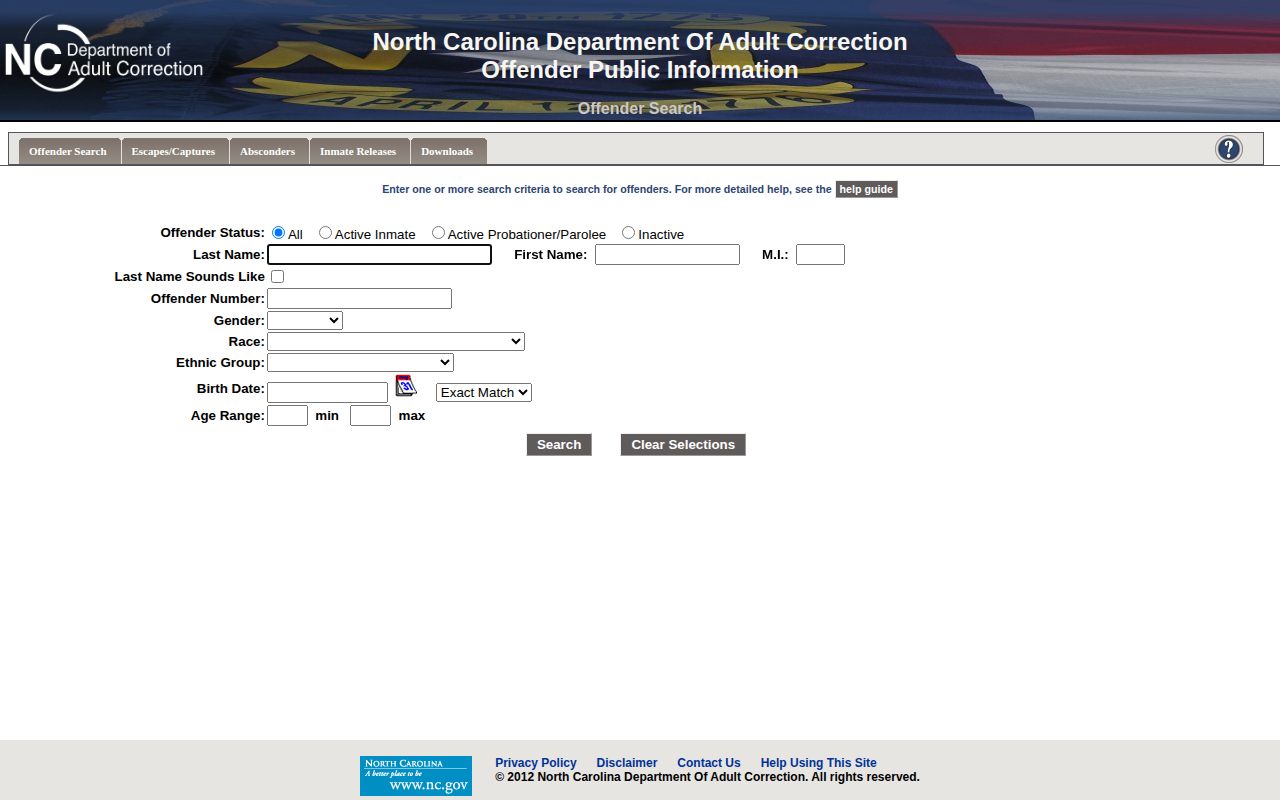
The search form begins a state-record lookup. It is not a county booking index, and the result must be opened before any projected date is interpreted.
Read Harnett OPUS Release Fields
OPUS is a durable state record for people who served state prison time or entered NCDAC probation, parole, or post-release supervision. Search by number when possible. With a name search, compare middle name, age or birth year, descriptive fields, and conviction counties without treating one detail as conclusive. A brief results-row status can hide the event sequence, so open the offender detail.
| OPUS area | Question it answers |
|---|---|
| Status | How NCDAC currently classifies the record at the displayed time. |
| Incarceration history | When a state custody segment began, moved, or ended. |
| Offense and sentence | The cases, terms, and sentence structure behind a calculation. |
| Projected or eligibility field | A prospective sentence-related date under the exact live label. |
| Release information | The actual event ending an incarceration segment when recorded. |
| Supervision history | Whether parole, probation, or post-release supervision followed. |
“Post Release” means a person is generally in the community under post-release supervision unless a later revocation or incarceration appears. Parole is mainly an older-law or special-category release. Probation can arise from a suspended or community sentence and does not itself prove a prison release. Final discharge is also distinct from leaving prison because supervision may continue after physical release.
Note: An OPUS release event confirms departure from NCDAC custody for that segment, not freedom from every local, federal, or immigration authority.
North Carolina Earned-Time Limits
The common “serve 85 percent” phrase is not a personal release-date calculator. NCDAC explains that Structured Sentencing abolished ordinary discretionary parole for offenses committed on or after October 1, 1994. It requires service of 100 percent of the minimum and at least 85 percent of the maximum. The court imposes both terms. Earned time works within that structure rather than subtracting 15 percent from any number someone selects.
G.S. 15A-1340.13(d) generally requires an active-sentence offender to serve the minimum. Earned time may reduce the maximum, but not below that minimum, apart from a specific route such as Advanced Supervised Release. G.S. 15A-1368.2 governs release to post-release supervision from the maximum term, the applicable supervision component, and earned time. The controlling statute version and offense date matter.
Advanced Supervised Release under G.S. 15A-1340.18 is a separate court-ordered path for defined eligible cases. When the mitigated range is used, the statute calculates an ASR date at 80 percent of the minimum, but eligibility, the court order, program conditions, and DAC decisions still control. It is not a general 20 percent reduction.
Harnett Jail Release Computation
A county jail sentence must not be calculated with the state-prison framework. G.S. 15A-1340.20(d) permits earned time on an activated misdemeanor sentence and caps combined rule and statutory credit at four days per month. G.S. 162-60 provides four days of reduction per 30 days for qualifying assigned work and certain education, rehabilitation, or training participation, subject to the cap and the custodian's determination.
The charge page alone cannot establish the Harnett County projected release date. Obtain the filed judgment, the sentence start, all jail credit, and any amended order from the Harnett court file. Then contact the Harnett County Detention Center at 175 Bain Street, Lillington, NC 27546, or 910-893-0257. Ask for the current custodian calculation and whether another hold or transfer affects the expected departure.
- Jail credit
- Time the court or custodian applies toward the active sentence.
- Earned time
- A credit governed by statute and agency rules, not a guaranteed early-release promise.
- Detainer
- A request or hold from another authority that may lead to continued custody or transfer.
- Discharge
- The end of the relevant sentence or supervision obligation, which may occur after prison release.
Why Harnett Release Dates Move
A projection is recalculated when the facts driving it change. Some changes move the date later, some move it earlier, and others change what happens on that date. The public record may not reveal every confidential detail behind a calculation. It should still show enough sentence and event context to frame a precise question for NCDAC or the county custodian.
| Factor | Possible effect |
|---|---|
| Earned-time award or forfeiture | Changes the credit applied within the statutory sentence boundary. |
| Disciplinary event | May result in loss of credit under applicable NCDAC rules. |
| Recalculated jail credit | Corrects time credited toward the controlling sentence. |
| Amended judgment | Changes a term, credit, or sentence structure through a court order. |
| Concurrent or consecutive cases | Changes how multiple terms run together or one after another. |
| Detainer or other hold | May turn release from one custodian into transfer to another. |
| Post-release or parole rule | Changes the next status and the legal point of transition. |
Special impaired-driving statutes and older sentences can follow different rules. Article 85 preserves parole rules for eligible older-law and categorical cases. No generic calculator can safely resolve those records without the offense date, sentence, and controlling law.
Harnett Release to Supervision
Leaving prison and completing a sentence are often two different dates. Eligible Structured Sentencing felons generally move to post-release supervision before final sentence termination. The North Carolina Post-Release Supervision and Parole Commission sets supervision conditions and handles revocation matters, while NCDAC Division of Community Supervision supplies field supervision. Old-law parole is conditional release for eligible cases. Probation may follow a suspended or community sentence and need not follow prison at all.
Read the OPUS supervision record after the incarceration event. Note the type, begin date, status, and termination date. Look for a later revocation or new incarceration. A projected prison-release date can therefore mark the expected start of supervision, not the day all state control ends. G.S. 15A-1368.2 supplies the statutory framework, and its current version must be matched to the offense and sentence dates.
Request Harnett Release Calculations
When an online result lacks the date or sentence event needed, ask for an existing record with enough detail to locate it. For NCDAC, provide the OPUS number and identify the incarceration segment, projected-date label, actual release event, or supervision start and end entries that need to be reconciled. The former online location for policy D.0600 returned an error during research, so it should not be cited as a current policy link. Ask NCDAC for the current public-offender-record policy instead.
For Harnett county custody, use the name, booking or docket number, admission date, judgment, and a narrow date range. Ask the detention custodian for the current release computation, recorded release date and time if the event occurred, disposition, and transfer agency when public. The Harnett County public-record request page accepts a form or email, but court orders and judgments must be requested from the clerk. North Carolina does not require an office to create a new analysis, so seek the records and fields that already exist.
There is no fixed Harnett turnaround promise in the research. Keep the request, response, estimate, and produced metadata. If no record is found, ask whether another custodian or a corrected spelling, identifier, or date would locate it.
Confirm Harnett Actual Release
After the projected date, reopen the source record. In OPUS, locate the actual incarceration event and then read the next status. If a field is missing or unclear, contact NCDAC Constituent Services with the OPUS number and the exact event or date to reconcile. Ask for existing public release information rather than confidential medical, treatment, security, or investigative material.
For county custody, call detention staff and request the recorded departure date, time, and disposition. Then check the Harnett court file for the judgment, release order, bond entry, or other filing that explains the legal change. A court order does not replace the jail's physical-release timestamp. If the date is still in the future, the Harnett County VINELink Inmate Search describes how to register for an offered release or transfer notice and then verify it with the reporting custodian.
Note: Keep projected release, scheduled release, actual custody departure, supervision start, and final discharge as separate entries in any personal notes.