
Harnett County Probation, Parole, and Post-Release
North Carolina uses three supervision terms that describe different legal paths. The distinction matters when deciding whether a dated entry proves release from prison. A probation record may exist with no state incarceration event at all. A parole or post-release entry should be read after the matching incarceration segment, then checked for a later revocation, return to custody, or termination.
| Supervision type | How it begins | What the record means |
|---|---|---|
| Probation | A court imposes supervision, often with a suspended or community sentence. | It proves a supervision sentence when matched to the case, but does not by itself prove a recent prison release. |
| Parole | An eligible person receives conditional release before sentence expiration under older or special parole law. | It marks community supervision after an eligible custodial sentence unless a later custody event changes the status. |
| Post-release supervision | Sentencing law places an eligible Structured Sentencing felon on supervision after imprisonment. | It is a statutory transition after prison, not ordinary discretionary parole. |
Key terms
Supervision begin date marks the start of the supervision segment. Status reports its current or recorded state. Termination date shows when that segment ended. Revocation may return a person to custody after release.
Verify Harnett County Post-Release Supervision
The North Carolina Department of Adult Correction maintains the statewide public path for state prisoners, probationers, parolees, and people on post-release supervision. The county jail roster is not the right search for these state records. Begin with an OPUS number whenever possible, because a stable number is safer than name alone.
- Open the official NCDAC criminal offender searches gateway or its linked Offender Public Information Search.
- Search by OPUS number. If only a name is known, compare middle name, birth year or age, listed identity details, and conviction counties before choosing a result.
- Open the full offender detail rather than relying on a result-row label. Read status, incarceration history, sentence information, release entries, and community-supervision history together.
- Record the supervision type, begin date, status, and termination date exactly as displayed. Look for a later revocation, new incarceration, or completed segment.
- If the public detail does not identify the responsible office or leaves an event unclear, contact NCDAC Community Supervision or Constituent Services with the OPUS number and the dated event.
- Use the Interstate Compact tracking link as a separate lead if supervision moved across state lines. Do not treat an interstate entry as proof that the North Carolina sentence has ended.
For a person known only through a county-jail booking, first confirm whether there was a state sentence or state supervision record. The Harnett County release-record guide separates a county departure from a state-prison release and provides the broader custody path.
Note: Read every dated segment; a valid release event can be followed by a violation, revocation, transfer, or later incarceration.
Who Handles Harnett County Supervision Records?
North Carolina separates the body that makes parole or post-release decisions from the officers who conduct field supervision. The North Carolina Post-Release Supervision and Parole Commission reviews eligible parole cases, sets conditions for post-release supervision, and handles revocation matters. NCDAC Division of Community Supervision employs probation and parole officers and operates offices statewide.
The NCDAC Community Supervision page shows the official agency and its statewide role:
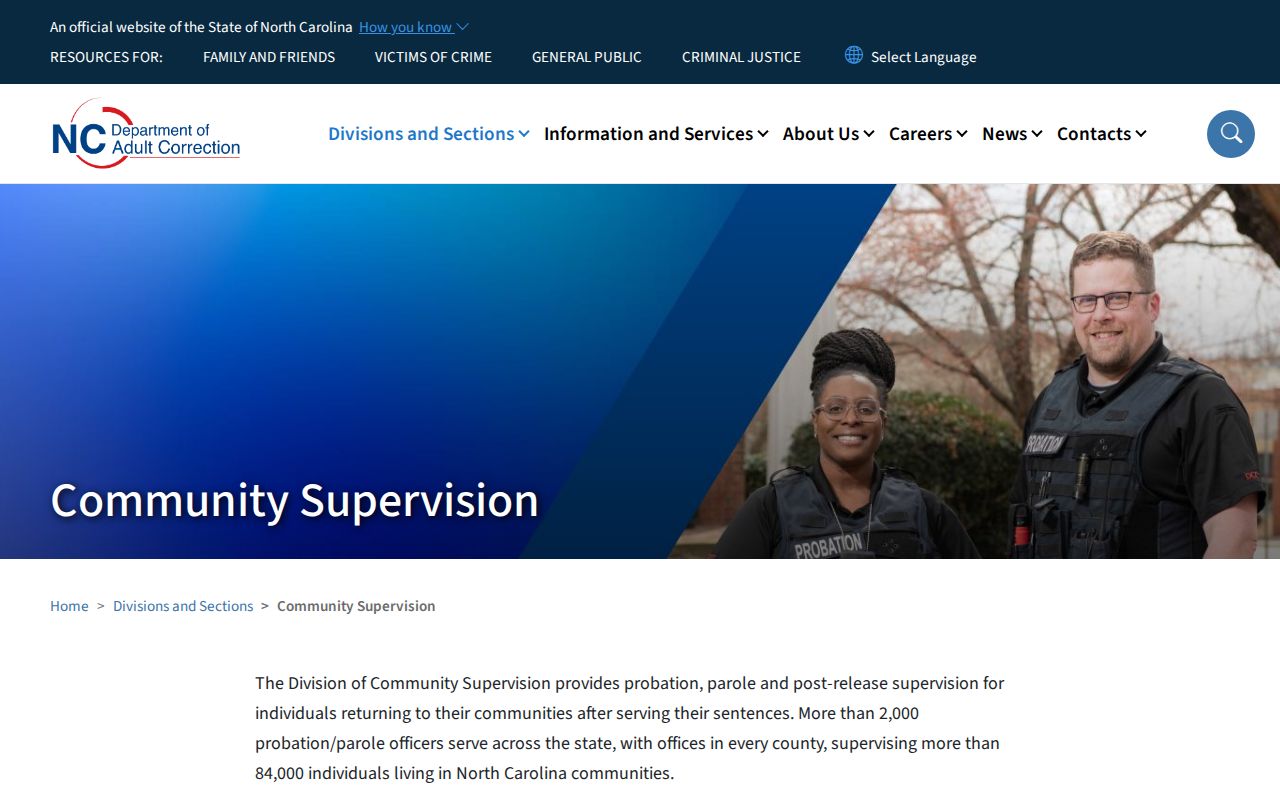
This statewide structure explains why a Harnett County case may be supervised by an office elsewhere after an approved transfer.
Official supervision contacts
Field supervision: NCDAC Division of Community Supervision
Public record help: NCDAC Constituent Services
Commission: 919-716-3010
Email: Parole.Commission@dac.nc.gov
Mail: 4222 Mail Service Center, Raleigh, NC 27699-4222
Street: 2020 Yonkers Road, Raleigh, NC
No verified Harnett-specific supervision office address or public hours appear in the research. Use the statewide official contacts to identify the responsible field office instead of publishing an unverified location or an individual officer's personal details.
Harnett County Parole Eligibility and Review
Ordinary parole eligibility mainly concerns crimes committed before October 1, 1994, with special statutory categories and exclusions requiring individual review. Structured Sentencing abolished ordinary discretionary parole for later offenses and generally requires service of the imposed minimum and at least eighty-five percent of the maximum. The rule is not a promise that every sentence receives a flat reduction.
The Commission's official parole process page explains eligibility and the Structured Sentencing boundary:
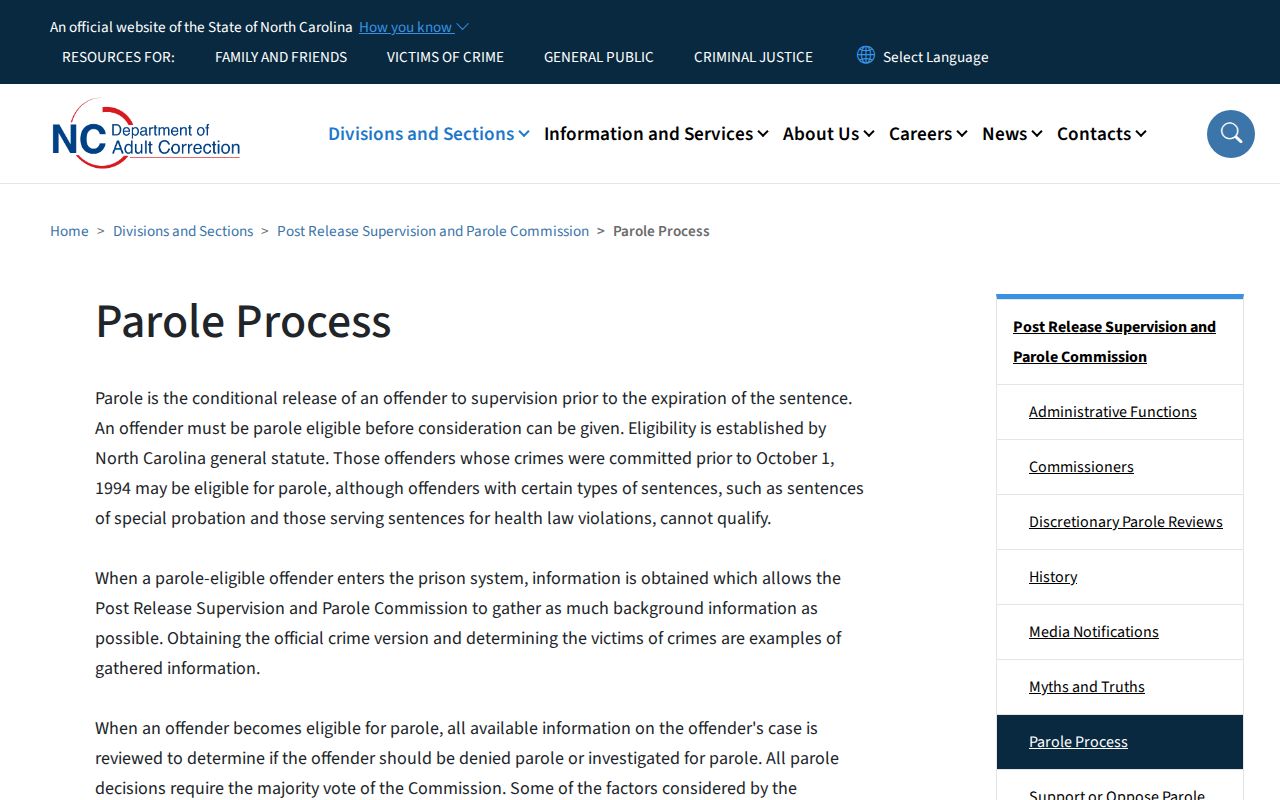
The official explanation is the right starting point, but the offense date, sentence, and controlling statute must still be matched to the individual record.
For eligible cases, the Commission generally conducts review at least annually after eligibility, subject to exceptions for murder and sexually violent offense cases. Article 85 of Chapter 15A contains the parole rules. A projected or eligible date is not an actual release event, and a Commission decision must be followed by the dated custody and supervision record.
The Harnett County Projected Release guide explains how to keep a prospective date separate from the actual release and supervision-start events.
Harnett County Parole Results, Not Hearings
North Carolina does not publish a conventional parole hearing calendar because the Commission states that it does not hold formal hearings or meet personally with offenders during parole review. Its process is a file review and majority decision. Meetings for victims or interested parties are separate and should not be described as an offender hearing.
The official Discretionary Parole Reviews page posts monthly reports beginning with September 2024. It is organized by month rather than as a searchable hearing docket. Its decision terms include incomplete decision, when more information is needed, and suspend decision, when consideration stops at that time. Selected investigations, approvals, and date changes may also appear in Commission media notifications.
Monthly results do not expose the entire file, and denial reasons or other Commission material can remain confidential. To verify one person, use OPUS and the Commission contact rather than assuming a monthly label proves physical release.
Note: Use “review,” “meeting,” and “hearing” precisely; North Carolina's file-review process is not an in-person offender hearing.
Harnett County Violations and Absconder Status
A violation entry or absconder status does not erase the earlier release. It means the person is alleged to have stopped complying or become unavailable to supervision, and an order, warrant, or revocation may follow. The status should be reported with its date and source, then checked for a later resolution or return to custody.
Do not attempt contact or apprehension. Verify an active warrant with the issuing agency. The Harnett County Sheriff's Office has Wanted Persons navigation on its official website, but that page is not a complete list of NCDAC supervision absconders. Absence there cannot clear a state violation or warrant.
For a filed Harnett criminal order or case event, use the official Harnett County court location page and its clerk directory. Court records and supervision records have different custodians, so compare dates without treating one system as a substitute for the other.
NC SAVAN and VINELink may offer custody or supervision notifications for a matching participating record. Read the reporting provider, event phrase, and update context. An alert can corroborate a new event, but it cannot replace OPUS, the supervising agency, or the authority that issued a warrant.
Harnett County Supervision Can Move
A supervising office is an administrative location, not reliable evidence of where a person lives. North Carolina supervision can move between counties, and the Interstate Compact governs approved supervision transfers across state lines. The NCDAC search gateway links the Interstate Compact Offender Tracking System for probationers and parolees involved in that process.
When office information conflicts with OPUS, start with the dated supervision record and ask NCDAC to identify the office responsible for the case. Do not publish an officer's personal contact information or infer an address from an office assignment. A transferred case can remain active under North Carolina authority even while another jurisdiction provides day-to-day supervision.
How Harnett County Supervision Ends
Supervision ends through a recorded termination or discharge event under the governing sentence and agency process. The end of an incarceration segment and the end of supervision are separate dates. A person may leave prison on post-release supervision, complete that supervision later, and only then reach the final end of the state correctional record segment.
In OPUS, preserve the exact type, begin date, status, and termination date. “Inactive” should not be translated without the dated history behind it. Likewise, an expected termination date is not proof that termination occurred. Check for later violations, extensions permitted by law, revocation, or new custody before concluding that the record is complete.
If the online display is unclear, ask NCDAC for the existing public incarceration and supervision entries using the OPUS number. Request the release-event date, release type, supervision start, and supervision end. Do not request confidential medical, treatment, security, victim, investigative, or psychological material.
Harnett County Reentry After Supervised Release
NCDAC publishes a Harnett County reentry resource directory that can help route a released person to local services. It is a directory snapshot rather than proof that every listed provider, telephone number, or program remains current. Contact details and availability should be checked with each provider before relying on them.
The directory is separate from supervision verification. It does not establish whether a person is on probation, parole, or post-release supervision, and it does not replace the responsible officer or NCDAC record. Its value is practical navigation after release while the official systems remain the source for legal status and case dates.
Note: Reentry listings can change; verify each provider directly while using NCDAC records for supervision status and custody history.